Geneva cross-border workers: the essential resources guide
Working in Switzerland while living in France is a great equation — a Swiss salary with a French cost of living. It is also a series of formalities you usually discover in the wrong order, and always slightly in a hurry: the permit, health insurance, taxes, transport, unemployment and, of course, housing.
This dossier covers them one by one. Each chapter stands on its own, with its tables, its figures (indicative orders of magnitude, always to be checked against official sources, as the rules evolve) and, at the end, a link to our detailed guide if you want to dig deeper. Whether you are a French cross-border commuter or an international newcomer taking up a position in Geneva, keep this page handy: it is the starting point of any successful move to the Geneva area.
How to read this dossier? No need to go through it all at once. Jump straight to the chapter that concerns you today — the permit if you have just signed, insurance if your 3-month window is running, housing if you are still searching — and come back as your installation unfolds.
1. Permit G: your cross-border status
What Permit G is (and is not)
Permit G — the cross-border permit — allows an EU/EFTA national to work as an employee in Switzerland while living in France. Crucially, it does not grant residence in Switzerland. That is what sets it apart from the other Swiss permits — the B (residence), the C (settlement) or the L (short stay), which all assume you live in Switzerland. The G formalises your cross-border status: you work in the canton, you go home to France, and your permit follows your contract.
Three cumulative, simple conditions:
- a work contract with an employer based in Switzerland;
- your home and centre of life in France;
- a return home at least once a week.
Good to know: for EU/EFTA nationals, the old requirement to live within a narrow "border zone" has been largely relaxed — you no longer have to live a few kilometres from the border. That is what lets many cross-border workers settle a little further out, where rents are gentler, without losing their status.
The application: who, where, with what, how long
In Geneva, your Swiss employer files the application with the Cantonal Office for Population and Migration (OCPM). So you do not chase counters yourself, but you must give them the documents to attach.
| Step | Who does what | Timeline |
|---|---|---|
| Initial application | The Swiss employer files with the OCPM | 2 to 6 weeks |
| Documents | Form + work contract + ID + proof of residence in France | — |
| Renewal letter | The OCPM writes to you before expiry | 2 to 3 months before |
| Renewal | You return the updated contract + recent proof (~65 CHF) | New permit within 2 to 4 weeks |
For an assignment of less than 90 days, no permit is needed: a simple notification procedure (online declaration by the employer) applies — the typical case for a short mission, a posting or a few weeks' trial.
How long is the permit valid?
| Type of contract | Validity of Permit G |
|---|---|
| Permanent contract | 5 years |
| Fixed-term over one year | 5 years |
| Contract under one year | The duration of the contract |
| Assignment under 90 days | No permit — notification procedure |
Renewal, without a validity gap
Renewal is almost automatic as long as you work in Switzerland — one of the great conveniences of the status. The OCPM writes to you 2 to 3 months before expiry; you return your updated contract and a recent proof of residence, pay about 65 CHF, and receive your new permit within 2 to 4 weeks. The right reflex: start as soon as you get the letter, so you are never left with an expired permit between two titles — a gap can complicate a lease, a loan or a border crossing.
Proof of residence: the document that blocks the most files
This is often what slows a first application, especially when you have just arrived without a stable home. Accepted proofs are usually a rent receipt, a recent utility bill or a proof of accommodation (if hosted by someone). The simplest and most solid is a lease in your name: it proves your address, your stability and your independence in one go. If you rent a coliving room with a clear contract, you have that proof from move-in day — a detail that then smooths the whole administrative chain (permit, bank, taxes).
Changing employer, losing your job: what stays valid
Permit G remains valid until its expiry date, even if you lose your job. You then claim unemployment benefits in France (see chapter 5), with no urgent permit step. If you find a new Swiss job, your cross-border status simply resumes. When you change employer, the permit is updated with your new contract — it follows you, it does not vanish at each transition.
A useful piece of context: under a 1973 agreement, the canton of Geneva pays part of the tax withheld from cross-border workers back to their French départements of residence (the "fonds frontaliers"). They help fund your local roads, schools and amenities: you contribute directly to the area you live in, even though your tax first goes to Geneva.
Go further: our full guide Permit G: the cross-border permit guide — step-by-step application, special cases, renewal.
2. Health insurance: the heaviest choice
This is probably the most structuring decision of your installation — and depending on your profile, the gap between the two options can be 100 to 300 CHF per month, sometimes more on extreme profiles. A mistake here is paid every month, for years.
The "droit d'option": 3 months, then it is locked
Within the three months of starting your Swiss job, you exercise your right of option: you choose, once, between two systems.
| Rule | Content |
|---|---|
| Deadline | 3 months after the start of the Swiss contract |
| Default (if you do nothing) | Automatic affiliation to LAMal |
| Reversibility | Irreversible in practice (except a change of situation, e.g. end of contract) |
| Cost tipping point | Around 65,000 – 70,000 CHF gross/year |
| Complement to plan for | A top-up ("mutuelle") is near-mandatory: €30 to €80/month |
The irreversibility is what many underestimate: once CMU is chosen, you do not easily return to LAMal. It is the question we get asked most at move-in — hence the importance of costing both before deciding, ideally before you even arrive.
How LAMal works (Swiss insurance)
It is the default option. You pick a Swiss insurer (Helsana, CSS, Swica, Groupe Mutuel…) and pay a monthly premium; the deductible is fixed for cross-border workers: 300 CHF/year, with no optional higher deductibles, unlike Swiss residents. Three things to understand:
- The premium varies with age, canton and chosen deductible, but not with your salary: whether you earn 4,000 or 12,000 CHF, it is the same amount. That is what makes it unbeatable on high incomes.
- After the deductible, a 10% co-payment applies, capped at 700 CHF/year: your annual out-of-pocket is bounded.
- LAMal covers care in Switzerland and in France (with the European health insurance card) and gives direct access to Swiss doctors without a referring GP.
On price evolution: LAMal premiums have historically risen 5 to 10% per year (with a peak of +16.6% in 2024). The good news: 2026 is a near-flat year for cross-border workers, with a very contained increase. But keep an eye on the horizon: a reform of the risk-compensation mechanism, which could raise premiums for cross-border policyholders, is expected for 2028 — worth anticipating in a choice that commits you for the long run. To compare insurers, use the official federal comparator, priminfo.admin.ch.
How CMU-PUMa works (French cover)
If you exercise your option within 3 months, you join the French system. Affiliation goes through the national centre for cross-border workers in Switzerland, run by URSSAF; your care then falls under your local CPAM. Here, no premium but a contribution of about 8% of your reference tax income (after an allowance). For a gross salary around 70,000 CHF/year, that is roughly €330/month; it rises for high salaries and falls for modest incomes.
Two trade-offs: cover is mainly on the French side, and you must follow a coordinated care pathway (declare a referring GP). The decisive upside: no deductible to advance, and a contribution that rises only if your salary rises — no annual increase imposed as with LAMal.
LAMal vs CMU: the comparison
| Criterion | LAMal (Swiss) | CMU-PUMa (French) |
|---|---|---|
| Cost basis | Age, canton, deductible — independent of salary | ~8% of reference tax income |
| Deductible | Fixed 300 CHF/year + 10% co-pay (max 700 CHF/year) | No deductible to advance |
| Evolution | Historically +5 to 10%/year; nearly stable in 2026, reform expected in 2028 | Rises only if salary rises |
| Care access | Swiss doctors directly, covers CH + FR | Coordinated pathway, GP in France |
| Best for… | High salaries (fixed premium) | Modest salaries (< ~65,000 CHF gross/year) |
By orders of magnitude observed in early 2026 for a 25-35-year-old, here is how the two cross over depending on salary. Note the table's logic: the LAMal premium does not move with your salary (it depends on your age, canton and deductible) — it is the CMU contribution that climbs with income. That is the very heart of the trade-off.
| Gross annual salary | LAMal premium (young adult)* | CMU-PUMa contribution | Option that stands out |
|---|---|---|---|
| 50,000 CHF | ~280 CHF | ~210 CHF | CMU |
| 65,000 CHF | ~280 CHF | ~300 CHF | Tie |
| 80,000 CHF | ~280 CHF | ~400 CHF | LAMal |
| 100,000 CHF | ~280 CHF | ~530 CHF | LAMal |
| 120,000 CHF | ~280 CHF | ~650 CHF | LAMal |
*Flat premium, independent of salary: it varies with age and insurer. The ~280 CHF figure corresponds to a 25-35-year-old at a competitive insurer; the cheapest offers start around 200 CHF. The deductible is fixed for cross-border workers (300 CHF/year), with a 10% co-pay capped at 700 CHF/year. Indicative orders of magnitude, individual situations vary.
The simple rule, and the reflex to build
Below about 65,000 CHF gross/year, CMU is often more favourable (proportional contribution, no deductible); above, LAMal's fixed premium wins and the gap widens with salary. But price is not everything: if you mostly see Swiss doctors, LAMal's freedom of access can justify a few francs more.
In both cases, plan for a top-up (€30 to €80/month) for dental, optical and fee overruns. And mind an often-forgotten point: as a couple or family, the calculation changes (pooled income for CMU, per-person premiums for LAMal) — simulate at household level, not just individually. The GTE (see the Resources chapter) and the cross-border brokers in Annemasse or Saint-Julien offer personalised, often free, simulations.
Go further: LAMal or CMU: the cross-border budget comparison, with worked profiles.
3. Taxes: paid in Switzerland, declared in France (and remote work)
The chapter that worries people most, yet its logic is clear once you break it down.
The three-step mechanism
| Step | Where | When |
|---|---|---|
| 1. Tax at source | Geneva, withheld by the employer | Every payslip |
| 2. Worldwide income declaration | France, on impots.gouv.fr | In spring |
| 3. Tax credit (neutralises double taxation) | France | When tax is calculated |
Step 1 — tax at source. Your employer withholds tax directly, on a Geneva scale: scale A for a single person without children, scale B for a married single earner, with other letters by family situation. For a single person, the effective rate is roughly 12 to 17% depending on salary — an order of magnitude, not an official scale, already including some standard deductions.
Step 2 — the French declaration. Even though tax is already withheld in Geneva, you still have to declare your income in France: as a French resident you declare all your worldwide income, converted into euros. Not declaring is a fault, even if you end up owing nothing.
Step 3 — the tax credit. The French-Swiss treaty (article 25A), binding the two countries since 1966, prevents double taxation: your Swiss income is added to the French taxable base, then a tax credit equal to the French tax on that same income is granted — it neutralises the tax. If you only have Swiss income, your French tax is generally nil or very low; in France you only pay tax on any French income (rent, investments).
From Swiss gross to real net: do not use the wrong number
Many reason on the gross salary in the contract — a classic mistake. Between gross and what lands in your account, you must deduct the Swiss social contributions (AVS/AI for pension and disability, AC for unemployment, LPP for occupational pension) then the tax at source. In total, the gap between gross and real net is often around 25 to 35%. It is that net, not the gross, that you must compare to your costs (rent, insurance, transport) when budgeting.
Your first French return, without a misstep
| Key point | Detail |
|---|---|
| Forms | 2042 (main) + 2047 (foreign-source income) + 2042-C if needed |
| The fatal error | Forgetting the 2047 → the tax credit is not applied, and you risk double taxation |
| Conversion | For 2025 income: official rate 1 CHF = €1.07 |
| 2026 calendar | Opens 9 April 2026; deadlines 21 May / 28 May / 4 June depending on the département |
The 2047 form is the keystone: it declares your Swiss income and triggers the tax credit. Forgetting it means risking being taxed twice on the same salary. Also mind CSG-CRDS: if you receive French property income (rent, capital gains), it bears social levies of 17.2%, even while working in Switzerland.
Quasi-resident status: the lever that can be worth a lot
Since 2021, if 90% or more of your household income is taxed in Switzerland, you can request quasi-resident status (subsequent ordinary taxation). The benefit: you then deduct actual expenses instead of the standard at-source scale.
| Criterion | Standard at source | Quasi-resident |
|---|---|---|
| Access condition | — | ≥ 90% of household income taxed in Switzerland |
| Deductible expenses | Basic deductions | Actual costs: third pillar, professional and commuting costs, loan interest, childcare, pension buy-backs |
| Effect | Baseline | A reduction of about 2 to 5 percentage points |
| Process / deadline | None | DRIS/TOU form, before 31 March |
As an illustration, on a 90,000 CHF salary the gain can be on the order of 150 to 375 CHF/month — several thousand francs over the year. But beware: it is not always a win (with few actual expenses to deduct, the standard scale may stay better), and the request must be filed every year, before 31 March — a deadline we remind our residents of every spring; after that, it is lost for the year. The reflex, whether or not you opt in: keep all your receipts (third pillar, commuting, loan interest).
The third pillar (3a): saving while paying less tax
A well-known lever for quasi-resident cross-border workers: the third pillar 3a, a Swiss retirement savings account whose contributions are deductible from taxable income. In 2026 the cap for an employee affiliated to the LPP is 7,258 CHF/year. Concretely, contributing that cap at a marginal rate of around 15% generates about 1,089 CHF of tax savings, nearly 91 CHF/month — while building your own savings. One of the rare schemes that wins on both fronts.
A 2026 novelty to know: it is now possible to retroactively fill contribution gaps from previous years (under conditions, and only for gaps arising from 2025 onward) — useful if you could not pay the maximum in some years.
Remote work: the 40% rule
Under the French-Swiss tax addendum — a permanent agreement signed on 25 July 2025 and applicable to income earned from 1 January 2026 — you can work from home in France up to 40% of your annual working time — about 2 days a week — without changing anything to your taxation: your whole salary stays taxed at source in Switzerland, as if you were 100% on site. Up to 10 days of assignments per year outside Switzerland count within that 40%.
| Share of remote work (annual, from France) | Tax regime | Social regime |
|---|---|---|
| Up to 40% (~2 days/week) | Salary 100% taxed in Switzerland | Swiss regime maintained |
| Above 40% | The remote-worked share becomes taxable in France from day one | Swiss maintained as long as < 49.9% |
| 49.9% and above (≥ 3 days/week) | Same as above | Risk of switching to French social security |
The trap is confusing two distinct thresholds: 40% for tax, 49.9% for social security. As long as you stay under 49.9%, you keep Swiss social security (pension, occupational pension, unemployment, health), thanks to a European framework agreement — but that requires an up-to-date A1 certificate, which your employer requests via the ALPS platform. Beyond 49.9% (3 remote days a week or more), you risk switching to French contributions, which changes everything: pension, occupational cover, health.
Two things to anticipate: your employer must be able to certify your remote-work percentage (via an addendum or signed agreement), and from 2027 they will have to report this figure to the Swiss cantonal tax authorities. As these thresholds and their rules may evolve, check what is in force each year with your employer and official sources.
Go further: Cross-border taxation in Geneva: 2026 rules, the return step by step, the remote-work tax addendum and the 2026 remote-work rules.
4. Transport: the line item that can change everything
Most cross-border workers still drive — convenient, but costly, and often a trap once every line is added up. Yet it is the fastest savings lever.
The Léman Express, backbone of the area
Since 2019, the Léman Express links many French municipalities to the heart of Geneva in around twenty minutes, with no traffic jams or border stress. Trains every 10 minutes at peak (every 15 minutes the rest of the day), from the first around 5:30am to the last around midnight, in modern air-conditioned units with WiFi and power sockets — time you can use to read, work or unwind. A monthly Léman Pass for zones 10+210 (Geneva + Annemasse agglo) costs €119.50, i.e. ~115 CHF — €82.90 for under-26s (tac-mobilites.fr), and many employers reimburse part of it: an often-overlooked perk, worth checking in your agreement. For combined tickets on both sides of the border, look at Unireso (the Geneva network), the TPG and the SBB/CFF.
The cross-border tram: Geneva like any city
Another direct, border-stop-free link, handy for those living on the Annemasse/Ambilly/Moillesulaz side: the cross-border tram (line 17). From Annemasse – Parc Montessuit or Ambilly – Croix d'Ambilly, it reaches the Terrassière stop, in the heart of Geneva (left bank, near Eaux-Vives), in around twenty minutes — a tram you catch like in any city, at high frequency, covered by an Unireso pass. One of the simplest connections in the area: no transfer, no parking, no waiting at the border.
Car, bike, bus, tram: the real comparison
| Mode | Monthly cost (order of magnitude) | Annemasse → Geneva | Reliability |
|---|---|---|---|
| Léman Express | ~115 CHF | ~20 min | Very high |
| Tram 17 (cross-border) | ~115 CHF (Léman Pass 10+210) | ~20 min (Croix d'Ambilly → Terrassière) | High |
| E-bike (amortised) | €40 to €115 (smoothed ~€60) | 25 to 40 min | High (8 months/12) |
| Bus (tpg / SNCF / Transdev) | ~70 CHF to €180 | 30 to 50 min | Medium |
| Carpooling | €50 to €200 | 25 to 50 min | Medium |
| Car (all-in) | 400 to 950 CHF | 20-25 min (40-60 at peak) | Low |
The real cost of a car, line by line
The calculation nobody makes before moving — and that changes everything:
| Line item | Monthly cost |
|---|---|
| Car insurance | €60 to €100 |
| Vehicle depreciation | €100 to €250 |
| Maintenance (smoothed) | €50 to €100 |
| Fuel | €80 to €120 |
| Geneva parking | 200 to 350 CHF |
| Swiss vignette (40 CHF/year, smoothed) | ~€3 |
| Total | ≈ 500 to 950 CHF/month |
Two figures stand out. First, parking alone accounts for 35 to 45% of the car budget: a city-centre Geneva parking pass costs 200 to 350 CHF/month, and meters reach 8 CHF/h in the red zone. Second, time: Google Maps shows "18 min" Annemasse-Geneva, but that is a time measured at 3am on a Sunday. At peak (7:30-9am, 5-7pm), it is rather 35 to 55 minutes, sometimes over an hour, because of the border crossings (Bardonnex, Moillesulaz) saturating from 7:15am.
Bike, carpooling, car-sharing
The e-bike is a genuine option 8 months out of 12: 25 to 40 minutes via the cycle paths (Moillesulaz, Chêne-Bourg), for a smoothed cost of about €40 to €115/month once the purchase is amortised — morning exercise included. It becomes impractical from November to March (rain, cold).
Carpooling (apps like BlaBlaCar Daily or Karos, local Facebook groups) comes to €50 to €200/month depending on sharing. And for occasional car needs (shopping, weekends), a car-sharing service such as Mobility, combined with the Léman Express and a bike, covers most trips for ~140 CHF/month, without owning a vehicle.
Match the mode to your workplace
Not everyone works at Cornavin. From a municipality like Ville-la-Grand, here are the real times by Geneva destination, by public transport:
| Destination | Route | Total time |
|---|---|---|
| Centre (Cornavin) | Léman Express direct | ~22 min |
| International quarter (Sécheron) | Léman Express direct + 10 min walk | 35 to 40 min |
| Plan-les-Ouates / Lancy | Léman Express → Lancy-Bachet + tram/bus | 40 to 50 min |
| CERN (Meyrin) | Léman Express → Cornavin + tram 18 | 50 to 55 min |
| Airport / Palexpo | Léman Express direct from Annemasse | ~30 min |
For hubs not served directly (Plan-les-Ouates, CERN), the good combination is often train + park-and-ride (P+R), folding bike or local bus — and the SBB/CFF app for real-time connections.
The one-year arbitrage
Added up, the gap is striking: a daily car costs 400 to 950 CHF/month; a good train + bike combination, 80 to 150 CHF/month. Over a year, giving up the individual car can mean 4,000 to 10,000 CHF in savings — the equivalent of 3 to 7 months of coliving rent. Enough to seriously reconsider the "all-car" reflex.
Go further: the real cost of cross-border commuting, Annemasse–Geneva by Léman Express and travel times district by district.
5. Unemployment: who compensates you, and how
A fast-moving area. The compensation rules for cross-border workers (in France) and EU/Switzerland unemployment coordination have been reformed recently, and further changes are under discussion. This chapter gives you the stable, undisputed mechanics; for any precise amount, rate or duration, check the current state with France Travail and the GTE before planning — this is the topic where a stale figure found at random does the most harm.
Why France pays (and not Switzerland)
If you lose your job in Switzerland while living in France, it is in principle your country of residence — France — that compensates you, through France Travail. This is the European social-security coordination principle: for a full cross-border worker in total unemployment, the country of residence takes over. Compensation follows French rules, applied to your converted Swiss salary.
The steps, in order
| Step | Action | Body |
|---|---|---|
| End of contract | Collect all your end-of-employment documents | Swiss employer |
| Certification of worked periods | Request the U1 (PD U1) form | Swiss unemployment authority |
| Opening of rights | Register as a jobseeker and file your claim | France Travail |
| Permit G | No urgent step: it stays valid until expiry | OCPM |
| Resuming a Swiss job | Your cross-border status resumes | Employer + OCPM |
Prepare without delay: your last three payslips, your Swiss contract and end-of-employment certificate, and of course the U1 form. The more complete your file at registration, the faster your rights open.
The U1 form, not to be forgotten
The U1 (formerly E301) is the portable document that certifies your insurance and employment periods in Switzerland. It is the bridge between the two systems: without it, France Travail cannot take your Swiss record into account to calculate your rights. Request it as soon as your contract ends, without waiting, as it can take time to obtain.
Total or partial unemployment?
The distinction matters. In total unemployment (you lost your job), France, your country of residence, compensates. In partial / short-time work (a reduction in hours decided by the employer), the situation may fall to Switzerland. The precise rules for calculation, duration and salary conversion change regularly — exactly the kind of point the cross-border associations (next chapter) track continuously, and where they support you in case of dispute with the administration.
(This chapter is deliberately shorter than the others: it is the only area where we prefer to point you to up-to-date official sources rather than quote amounts that may have changed. Caution here protects your rights.)
6. Housing: the real challenge
This is often headache number one: a tight market, agencies puzzled by an "atypical" file (Swiss contract, no local guarantor), short notice. But with the right method, it is very manageable.
The rent map, municipality by municipality
Crossing the border means dividing the rent by 1.5 to 2. A studio at 2,000 CHF in Geneva centre drops to €700-800 on the French side — on the rent alone, around 15,000 CHF of savings per year. Here are the orders of magnitude observed in early 2026, for a single person:
| Location | Studio | Room in a flatshare |
|---|---|---|
| Geneva centre (Eaux-Vives, Plainpalais) | 1,800 – 2,500 CHF | 1,200 – 1,600 CHF |
| Geneva outskirts (Lancy, Onex, Vernier) | 1,400 – 1,800 CHF | 900 – 1,200 CHF |
| Annemasse centre / station (Léman Express) | €800 – 1,150 | €550 – 800 |
| Ville-la-Grand · Ambilly | €700 – 1,000 | €500 – 750 |
| Gaillard | €700 – 950 | €500 – 700 |
| Cranves-Sales · Vétraz-Monthoux | €650 – 850 | €450 – 650 |
(Indicative ranges; La Villa Coliving — all-inclusive premium coliving in exceptional houses: pool, sauna, gym… — sits around 1,370 CHF/month.) Note: the second-ring municipalities (Cranves-Sales, Vétraz-Monthoux, Bonne) are 10 to 15% cheaper than Annemasse centre for 5 to 10 minutes more travel — an arbitrage that often pays off.
Go further: the cross-border housing observatory — studio rent crossed with commute time, town by town
The "attractive rent" trap
An advertised rent is never the real cost, even in France. Add the charges and the bill climbs fast:
| Monthly line item | Order of magnitude |
|---|---|
| Electricity / heating | €50 to €120 |
| Fibre internet | €30 to €40 |
| Home insurance | €15 to €25 |
| Household waste tax | ~€15 |
The result: a studio advertised at €750 often comes to €1,050 to €1,140 real once everything is counted (+40 to +50%), not to mention €2,000 to €5,000 to furnish an empty home. That is the whole point of an all-inclusive offer: a single amount, total predictability, and no year-end charge adjustments.
The 30% rule and your salary
The classic, indicative rule: do not spend more than 30% of your net income on housing. With a median cross-border net salary around 5,500-6,000 CHF, that puts your housing budget around 1,650-1,800 CHF — comfortable for a room on the French side, tight for a studio in Geneva. Net salaries vary widely by sector (administration, retail, tech, finance, pharma, watchmaking, international organisations, hospitality), which is why you should reason on your real net, not an average.
Building a file that goes to the top of the pile
Your Swiss salary is not the problem — it is the format of your documents that puzzles the French landlord. A complete, readable file removes the doubt:
| Document | Why |
|---|---|
| Swiss work contract + free translation of key points | The Swiss format is unsettling; clarifies contract type, employer and salary |
| Last 3 payslips (net highlighted, converted into €) | Spares the landlord from converting the CHF themselves |
| Employer attestation | "The document that makes the difference": role, seniority, probation passed |
| Latest tax notice | Proof of fiscal stability |
| Guarantor (or Visale / Garantme) | Required if net income < 3× the rent |
| Copy of Permit G | Proves your situation is official and regulated |
No French guarantor? The Visale guarantee (Action Logement, free, under age or mobility conditions) or paid services such as Garantme/Cautioneo (3-4% of the annual rent) step in. A single, clean, well-organised PDF with a short cover note often makes the difference in a market where several candidates apply.
Scams to spot before paying
A tight market attracts fraudsters. Five patterns recur: the fake "abroad" landlord who cannot show the property, the rigged lease signed by someone who is not the real owner, illegal hidden fees, illegal subletting, and fake platforms imitating well-known sites.
| Type of scam | Warning sign | How to check |
|---|---|---|
| Fake "abroad" landlord | Money requested before any viewing, price below market | Reverse image search, video call from the property |
| Rigged lease | Pressure to sign the same day, lease with no diagnostics (DPE) | Require the property tax in the signer's name + their ID |
| Illegal hidden fees | Excessive application fees, "booking fees", inflated deposit | Know the law, refuse cash, demand receipts |
| Fraudulent platform | Payment requested before even seeing the listings | Check the exact domain, look for real reviews |
The golden rule: never any money before you have viewed AND verified the landlord's identity. Bank transfer only (never cash, never Lydia/PayPal), and be wary of a price that is too low or pressure to sign. When in doubt, the ADIL of Haute-Savoie (free public service, 04 50 45 79 72) answers your questions. If you are a victim, act fast: report the listing, file a complaint, and contact your bank — a fund recall is sometimes possible within 24-48h. You can also report the fraud via THESEE (online complaint) and SignalConso.
Finally, on entry fees: on the coliving and flatshare market they frequently range from €200 to €700, on top of the security deposit (often two months' rent excluding charges for furnished) — a line item to always cost before committing.
The right timing, and the inventory
The market breathes with the year: September-November is a lull good for negotiating, January-March tightens, June-August offers more choice but at the highest prices. And whatever the home, never sign without a detailed joint move-in inventory ("état des lieux"), with photos: it is your best protection for getting your deposit back when you leave.
Go further: the real budget of cross-border housing, how to build your rental file, spotting scams, rents municipality by municipality and the 5 mistakes to avoid. And for daily life: bank, phone, internet good deals.
Resources and contacts to know
You do not have to figure everything out alone. A few allies make settling in far simpler:
- Groupement transfrontalier européen (GTE): THE reference for cross-border workers around Lake Geneva, with over 20,000 members. Reliable legal, tax and social information, individual consultations and simulations (notably for the LAMal/CMU choice and the tax return), support with formalities and disputes, collective advocacy, and the Frontalier Magazine. The place to follow regulatory changes explained clearly.
- International Geneva Welcome Centre (CAGI): the welcome desk of International Geneva. If you arrive through an international organisation, an NGO or a permanent mission, make it your first stop: personalised welcome, settling-in support, a housing service dedicated to internationals, and integration programmes — invaluable if you land without speaking French yet.
- glocals: Geneva's English-speaking expat community, great for asking questions and building a network from day one.
- Genève Pas Cher and La Maison Transfrontalière: practical resources for everyday cross-border life (good deals, formalities, local life on both sides of the border).
- The cross-border sections of the local press — Le Messager, Le Dauphiné Libéré — to follow the area's news (taxes, transport, employment).
- The Cross-border statistical observatory for reliable data on employment, housing and mobility.
And at La Villa?
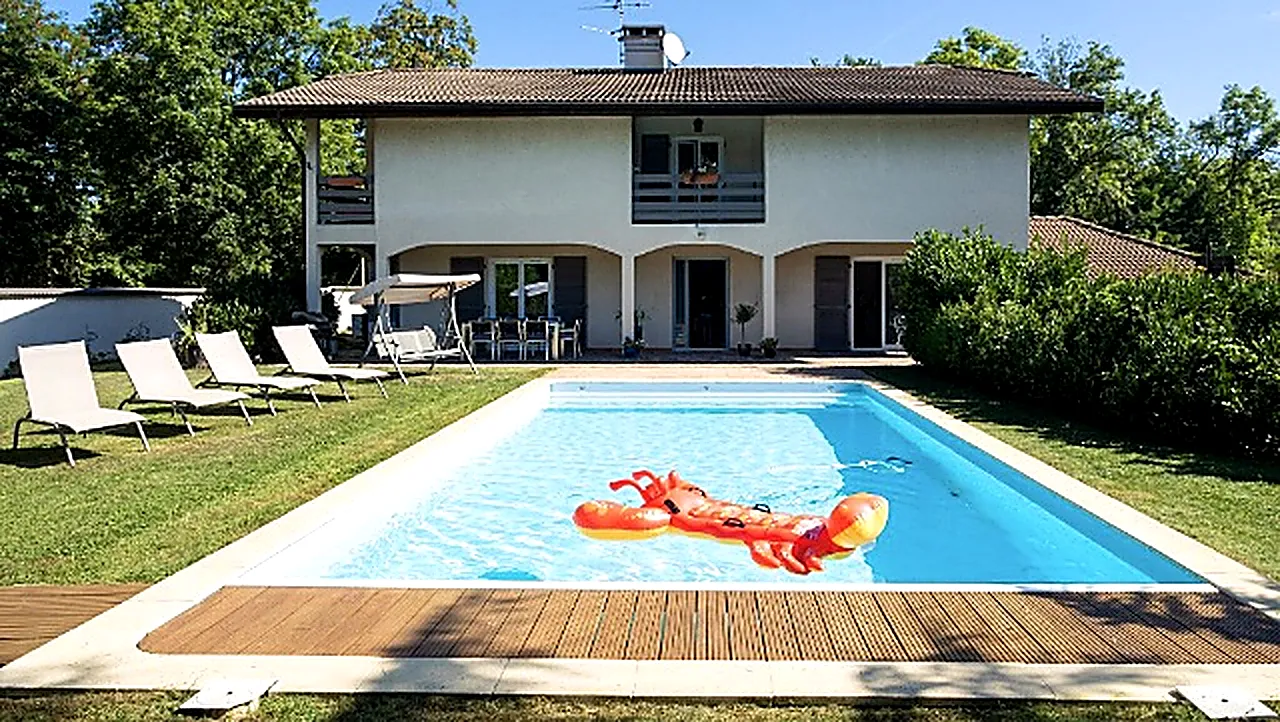
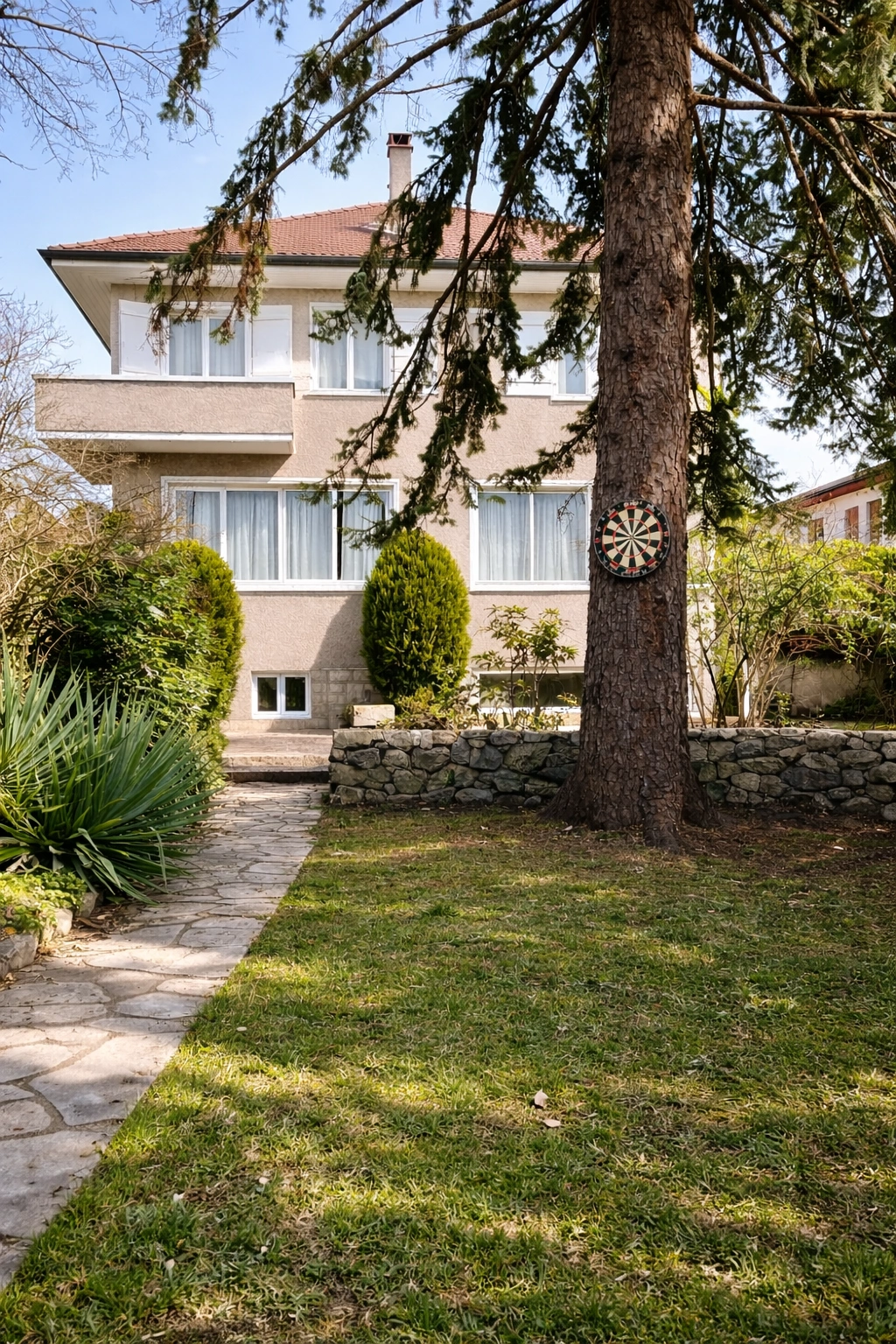
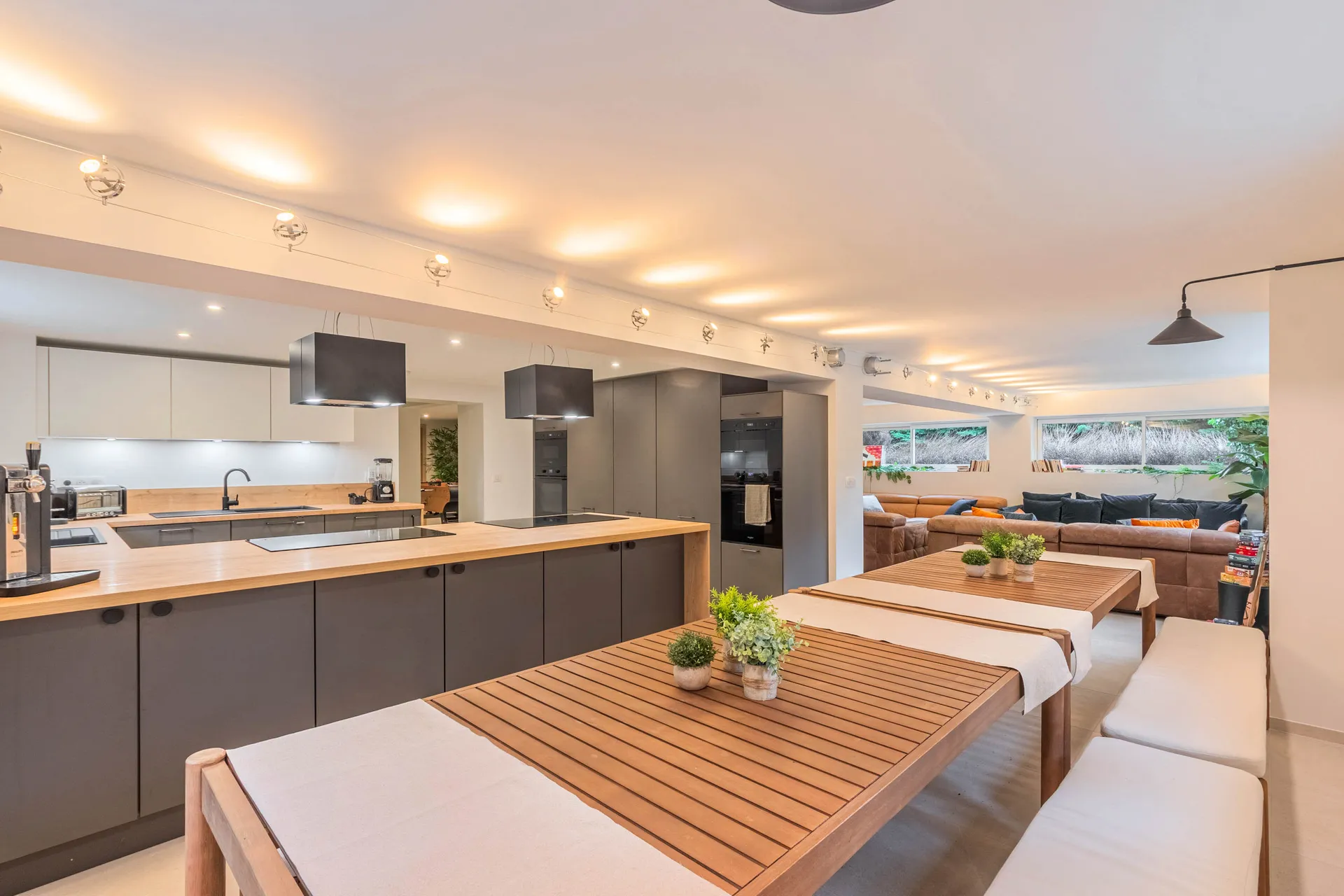
We sit on the other side of the mirror: owners, not an agency. La Villa Coliving is a set of houses with all-inclusive furnished rooms about twenty minutes from Geneva, on the French side, designed for cross-border workers, young professionals and expats.
Two things that matter when you move:
- You move in with zero entry fees. No application fee, no agency fee, no booking fee. You pay your first all-inclusive rent and a fully refundable deposit — that is it. Because we rent out our own houses directly, there is nobody between you and us to pay. It is not a promotion, it is our model.
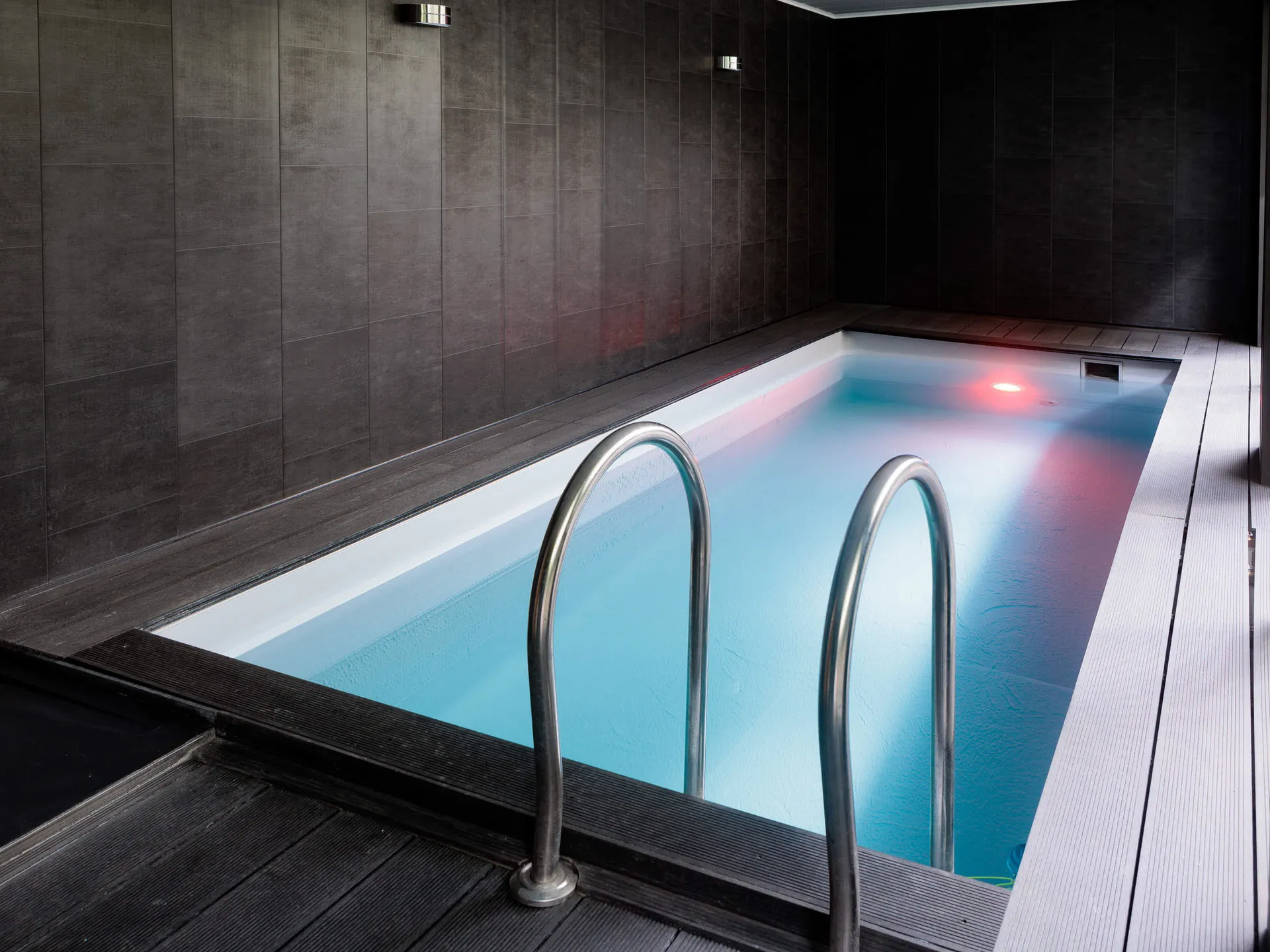
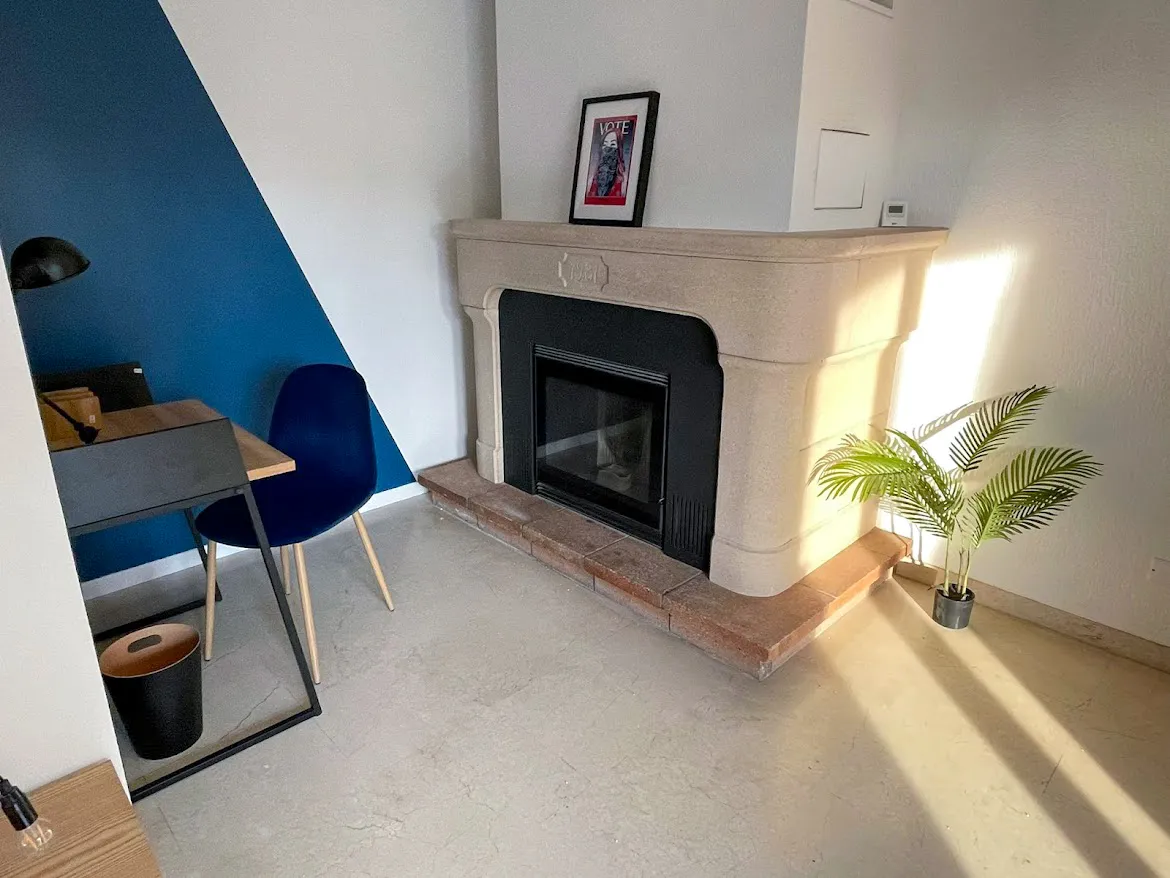
- Everything is included, and you have a single point of contact. Rent, utilities, high-speed internet, cleaning of the common areas, access to the facilities (depending on the house: heated pool, sauna, gym). From 1,370 CHF/month. The advertised price is the price you pay — and your lease immediately gives you the proof of residence you need for Permit G.
Discover our see our rooms on the French side and our all-inclusive rates.
FAQ — the questions we hear most
How long does it take to get Permit G? Usually 2 to 6 weeks after your employer files the application with the OCPM. For an assignment under 90 days, no permit is needed: a simple notification procedure applies.
When do I have to choose my health insurance as a cross-border worker? Within three months of starting your job in Switzerland. You opt either for LAMal (Swiss insurance, compare on priminfo.admin.ch) or for the French social security (CMU/PUMa, via URSSAF). The choice is generally irrevocable: put numbers on both before deciding.
LAMal or CMU: which is cheaper for me? It depends on your salary. Below roughly 65,000 CHF gross per year, CMU is often more favourable (proportional contribution, no deductible); above, LAMal wins because its premium is fixed, independent of salary.
I already pay tax at source in Switzerland — do I still need to file in France? Yes. Tax is withheld at source in Geneva, but you must still declare your income in France (forms 2042 and 2047); the French-Swiss treaty prevents double taxation through a tax credit. Forgetting the 2047 is the classic mistake.
How much can I work remotely without changing my taxation? Up to 40% of your annual time (about 2 days a week, including 10 days of assignments per year): your whole salary stays taxed at source in Switzerland. Beyond that, the remote-worked share becomes taxable in France from day one. Watch the separate 49.9% social-security threshold.
What is the quasi-resident status in Geneva? A tax status that lets you, if 90% or more of your household income is taxed in Switzerland, deduct your actual expenses (third pillar, commuting, loan interest…) instead of the at-source scale. It is requested every year, before 31 March — keep your receipts.
Who compensates me if I lose my job in Switzerland? In principle France (your country of residence), through France Travail, under French rules and based on your converted Swiss salary (U1/PDU1 form). The rules are evolving: check the current state with France Travail and follow the GTE. Your Permit G stays valid until its expiry.
Are there application fees to rent a home on the French side? It depends on who manages the property. An agency may charge fees regulated by law (often €200 to €700 at entry on this market). When you rent directly from the owner — as at La Villa — there is no agency, hence no application or agency fees.
How much rent will I really pay on the French side? For a single person, count a studio between €650 and €1,150 or a flatshare room between €450 and €800 depending on the municipality, versus 1,800 to 2,500 CHF for a studio in Geneva centre. Add the charges (often +40 to +50% of the advertised rent) — hence the appeal of an all-inclusive offer.
In short
Becoming a cross-border worker means clearing six steps — permit, insurance, taxes, transport, unemployment, housing — none of which is insurmountable when you know where to look. Keep this dossier within reach, lean on the associations that know these topics inside out, and always check amounts against official sources, since the rules evolve. And if you want to settle quickly, with zero entry fees, near Geneva, discover our houses or apply in a few minutes, for free.
👉 Looking for see our rooms on the French side? At La Villa Coliving (Ville-la-Grand, Ambilly and Annemasse), a fully furnished all-inclusive room costs from CHF 1,370/month — utilities, fiber and cleaning included, no application fee — 15-20 minutes from Geneva by Léman Express or tram.