The 40% Tax Rule: Cross-Border Work 2026
The 40% telework rule is not new: it has applied since 2023 via a transitional agreement. What changes on 1 January 2026 is that it becomes permanent — an amendment to the France–Switzerland tax treaty replaces the temporary Covid-era arrangements and now comes with formal monitoring. Here's what actually changes for your taxation, in plain language. New to the topic? Start with La Villa's permis G explainer, the status everything else rests on.
What is the Franco-Swiss tax amendment?
It's a change to the double-taxation treaty that has linked France and Switzerland since 1966. This amendment was signed on 27 June 2023, entered into force on 24 July 2025, and applies to income earned from 1 January 2026 (entry into force — ge.ch). Its goal: replace the temporary Covid-era arrangements with a stable rule. As a result, both cross-border workers and employers finally know where they stand.
How does the 40% threshold work?
The rule fits in one sentence: as long as you telework up to 40% of your annual working time from France, your entire salary remains taxed at source in Switzerland (official rule — ge.ch), exactly as if you were on site 100% of the time. Over a 5-day week, that's 2 days of telework per week. Good to know: up to 10 days per year of temporary assignments outside Switzerland (in France or a third country) count within that 40%.
What happens if I exceed 40%?
If you cross the threshold, the portion of your salary corresponding to your teleworked days becomes taxable in France — and from the very first teleworked day, not only for the days above 40% (official detail — ge.ch). To prevent you from paying twice, the treaty applies a tax credit (article 25A). In short: above 40%, your tax return gets a little more complex. The simplest approach is to stay under the threshold — the advice we give our residents in this situation; if your job requires more, get help from a fiduciary specializing in cross-border taxation. Cross-border workers' associations also hold advice sessions, notably on tax returns; they are listed at lavillacoliving.com/en/blog/guide-ressources-frontalier-geneve.
Don't confuse tax and social security
The 40% threshold concerns only your taxes. For your social security (AVS, LPP, health insurance), a different threshold applies: you can telework up to 49.9% while staying in the Swiss system, thanks to the European framework agreement — provided you hold a valid A1 certificate, requested by your employer. Two thresholds, two logics: we cover it all in our cross-border telework guide.
What does it change for my 2026 tax return?
Two practical things. First, since 1 January 2026, your Swiss employer must track your telework and assignment days, then report your annual rate to the Swiss tax administration (AFC) in early 2027. Second, you still declare your income in France (form 2047), where the tax credit offsets the tax already withheld in Switzerland. If you stayed under 40%, nothing changes versus previous years. To fill in form 2047 without mistakes, follow La Villa's 2026 tax return walkthrough. For the gross-to-net calculation, see our cross-border tax guide.
What about the "compensation" between the two countries?
A bit of context that doesn't affect your wallet: in exchange for keeping the right to tax telework, Switzerland pays France a compensation equal to 40% of the tax collected on teleworked remuneration. It's an arrangement between States — you, the cross-border worker, owe nothing extra.
Geneva, a regime of its own
A key point many miss: Geneva is not part of the 1983 cross-border agreement (which covers 8 cantons: Bern, Solothurn, Basel-City, Basel-Country, Vaud, Valais, Neuchâtel and Jura). For those 8 cantons, the cross-border worker is taxed in France. Geneva is the opposite: you are taxed at source in Geneva, then a tax credit offsets the French tax (1966 treaty). It's also why Geneva rebates 3.5% of its cross-border workers' payroll to the Ain and Haute-Savoie departments (agreement of 29 January 1973). This is the cornerstone of Geneva cross-border taxation.
Two days of telework a week, in practice
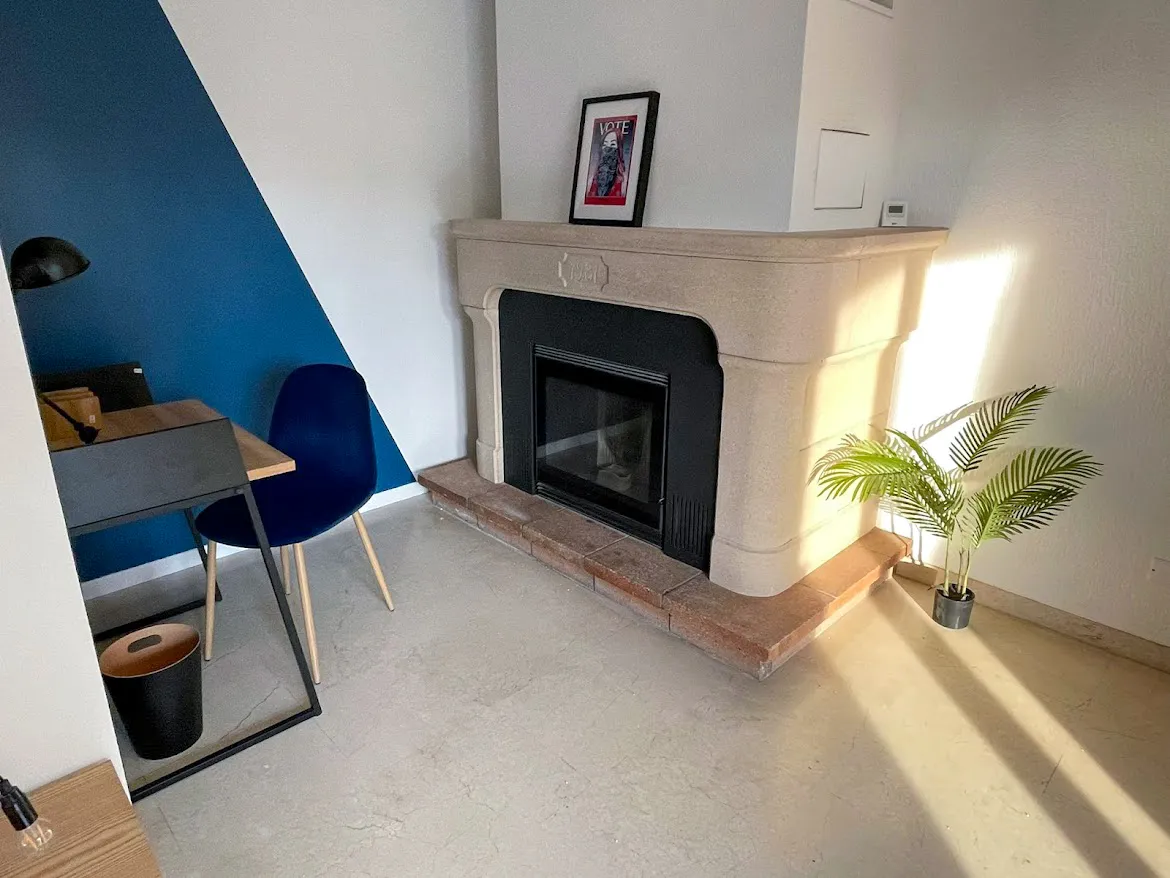
The real good news of the amendment is that 2 weekly telework days (40%) are now fully compatible with both your Swiss tax and social-security status — something we see every week with our residents who work from home. You still need a proper place to work. In coliving, every room has a desk and fiber sized for video calls, and the common areas create an informal coworking vibe on days when several residents work from home. A great way to enjoy those days on the French side without the isolation of a studio. Discover our houses.
In short
- Tax: 40% annual telework → salary 100% taxed in Switzerland.
- Social: 49.9% (A1 certificate) → Swiss social security maintained.
- 2 days/week = 40%: compatible with both thresholds.
- Above 40%: taxed in France from the first teleworked day, with a tax credit.
- A permanent rule since 1 January 2026.
Questions about your cross-border situation? Get in touch — it's a topic we know well.
Also read:
- Remote Work for Cross-Border Workers: Rules & Limits 2026
- Geneva Cross-Border Tax: net pay 2026
- Living in France, Working in Geneva: the complete guide
👉 Looking for a place on the French side? At La Villa Coliving (Ville-la-Grand, Ambilly and Annemasse), a fully furnished all-inclusive room costs from CHF 1,370/month — utilities, fiber and cleaning included, no application fee. Geneva Eaux-Vives in 7 minutes by Léman Express from Annemasse station — 18 to 24 minutes door to door depending on the house, 30 minutes to the city centre. → La Villa Coliving, French side