Swiss net salary 2026 for frontaliers
You've landed a job in Geneva — or you're already working there — and the question is simple in appearance: how much actually lands in your account each month? Between the gross figure on your contract, mandatory deductions, source tax, and the CHF/EUR conversion, the path from a Swiss gross salary to a real frontalier net deserves a clean calculation. Here's the honest 2026 grid, with concrete examples.
Your Swiss gross is not your net (and that's normal)
Just like in France, the gross figure on your Swiss contract is not what hits your account — the first thing we clarify with our residents starting a job in Geneva. Four mandatory deductions apply to every salary — whether you're a Swiss resident or a cross-border worker — before we even mention tax.
| Deduction | Employee rate 2026 | Annual cap |
|---|---|---|
| AVS / AI / APG (pension, disability, allowances) | 5.30 % | none |
| AC (unemployment insurance) | 1.10 % | on first 148,200 CHF |
| LAA-NP (non-occupational accident) | ~1-2 % | none |
| LPP (pension fund, 2nd pillar) | 5-9 % | varies by age and fund |
Important: LAMal (mandatory Swiss health insurance) is NOT deducted at source for cross-border workers. It's a separate monthly premium (280 to 450 CHF/month depending on your age and provider). If you've opted for CMU on the French side, you pay roughly 8 % of your taxable income — often cheaper early-career. See our LAMal vs CMU guide.
Real example with 7,000 CHF gross/month (≈ 84,000 CHF/year):
- AVS/AI/APG: 371 CHF
- AC: 77 CHF
- LAA-NP: 105 CHF
- LPP (age 35, average fund ~7 %): 490 CHF
- Net before tax = 5,957 CHF
So you're already at ~15 % deductions before any taxation. That's in line with European averages for a defined-benefit pension system.
Cross-border: source tax changes the game
This is where Swiss residents and cross-border workers diverge. You work in Geneva but live in France? Your employer withholds source tax directly on your payslip, based on the Canton of Geneva rate schedule. It's usually more favourable than a standard Swiss filing — and much more than French taxation for the same salary level.
What you actually pay in source tax
The Geneva schedule is progressive and depends on your family situation. The rate below is the total effective source tax (federal + cantonal + communal) — Geneva sits in the higher-tax bracket among Swiss cantons. 2026 ballpark for a single frontalier with no children (category A0):
| Annual gross salary | Effective source tax rate |
|---|---|
| 60,000 CHF | around 9 % |
| 80,000 CHF | around 14-15 % |
| 100,000 CHF | around 17-18 % |
| 130,000 CHF | around 20-21 % |
| 180,000 CHF | around 22-23 % |
With a spouse and dependents (category C or H), expect 2 to 4 points lower. Always cross-check on the official Geneva simulator (admin.ge.ch).
And what about French taxation?
No — that's the whole point of the Geneva cross-border status. The Franco-Swiss convention (1966, last updated 2023) means salary income taxed at source in Switzerland is not re-taxed in France. You still declare it on your French return (form 2042-C), but only to compute the effective rate on your other income (rental, dividends, etc.). Details in our Geneva frontalier tax guide 2026.
Watch out for the 40 % rule (2024+): if you remote-work more than 40 % from France, you flip to French taxation — much less favourable. Read Geneva cross-border remote work 2026.
Swiss salaries by role: the honest 2026 grid
Beyond the gross/net mechanics, the real question: what salary should you target for what role in Geneva in 2026? Here are 2026 medians (sources: OFS, Salarium, Glassdoor Geneva, 2025→2026 inflation/market adjustments) — all roles for ages 30-40 with ~5 years of experience, full-time permanent contract. Estimated monthly net assumes single no-children (category A0), Geneva 2026 source tax, excluding LAMal/CMU premium.
| Role family | Gross median / month | Gross median / year | Estimated monthly net (category A) |
|---|---|---|---|
| Technical, admin support | 6,000 CHF | 72,000 CHF | ~4,400 CHF |
| Healthcare (nurse, technician) | 7,500 CHF | 90,000 CHF | ~5,300 CHF |
| Engineering, IT (developer, data analyst) | 8,500 CHF | 102,000 CHF | ~5,950 CHF |
| International organisation staff (WHO, UN, ICRC) | 9,200 CHF | 110,000 CHF | ~6,350 CHF |
| Banking, finance (analyst, audit, advisory) | 11,000 CHF | 132,000 CHF | ~7,400 CHF |
| Physicians, medical specialists | 12,500 CHF | 150,000 CHF | ~8,200 CHF |
| Executives (industry, multinationals) | 16,000 CHF + | 192,000 CHF + | ~10,200 CHF + |
These are medians: half earn less, half earn more. In Geneva, the inter-quartile range is very wide in banking/finance and tech (single to triple depending on company, bonus, product type). Best practice: cross-reference Glassdoor, LinkedIn Salary Insights, and your network before negotiating.
Cross-border vs Swiss resident: who nets more?
Honest answer: it depends on your profile and lifestyle.
Cross-border advantages: source tax often lower than Swiss resident filing, rent 30-50 % cheaper on the French side, groceries 30-40 % cheaper, CMU option for modest income, no Swiss filing complexity.
Swiss resident advantages: no daily border commute (1-2 h gained per day), 3rd pillar 3a accessible with tax deduction, full Swiss pension contributions, more favourable LAA-P access, no CHF/EUR currency risk.
For the same role at 100,000 CHF gross/year, a cross-border worker living in Annemasse Agglo typically takes home 15-20 % more net disposable income than a Geneva resident — once rent, groceries, and commute are factored in. Your mileage varies with family situation and commute.
3 levers to optimise your frontalier net
1. The 3rd pillar 3a if eligible
Most frontaliers can't use it (unless you have quasi-resident status). But if you can, the 2026 cap is 7,258 CHF/year, fully deductible. Typical tax saving for an executive at 100,000 CHF: 1,200 to 1,800 CHF/year. See our 3rd pillar guide.
2. The housing arbitrage (the biggest lever)
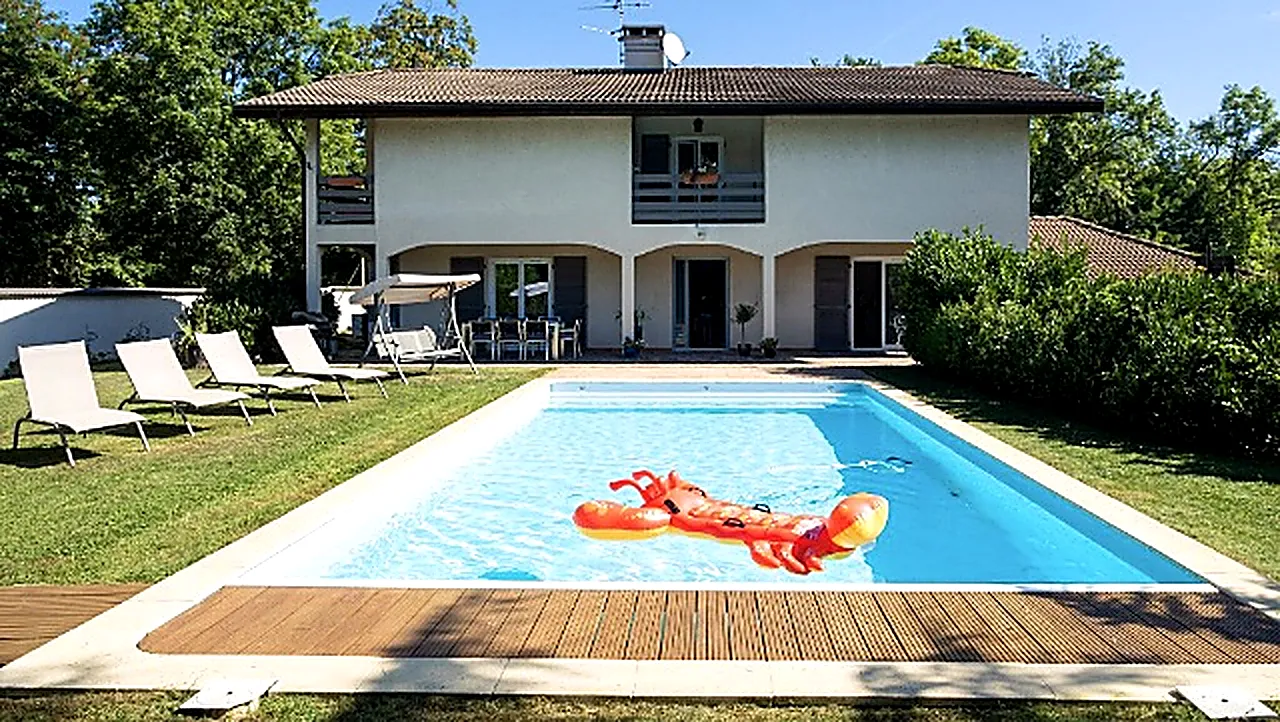
At equivalent square metres, living in Annemasse rather than central Geneva saves 800 to 1,800 CHF/month in rent — 9,600 to 21,600 CHF/year. This is exactly the trade-off our residents make, and we live it with them daily. Push it further with all-inclusive coliving: utilities, internet, cleaning, pool/gym subscriptions all included. Numbers in our all-inclusive coliving savings. Discover our shared housing near Geneva or Annemasse coliving option.
3. Optimised French tax return
Even though your Swiss salary isn't re-taxed, your French return matters for the effective global rate. Filling it well avoids costly mistakes (over-taxed rental income, wrong RFR, lost social benefits eligibility). Step-by-step in our frontalier tax filing guide 2026.
Swiss salary FAQ
What Swiss salary equals 5,000 € net in France? Around 8,500 to 9,500 CHF gross/month for a single category-A0 frontalier (102-114k CHF gross/year). CHF/EUR ratio (~1.07 mid-2026) works in your favour, but GE source tax is higher than commonly assumed.
What's the real net on 100,000 CHF gross/year in Geneva? About 5,985 CHF/month net after mandatory deductions (~10 %) and Geneva source tax (~18 %) (category A, single, no dependents). Roughly 6,400 EUR/month at 1.07 rate — before LAMal/CMU premium. With spouse and children (cat. C/H), add 400 to 700 CHF/month. For your family entitlements, see our frontalier family allowances guide.
Is the 13th-month salary mandatory in Switzerland? No, not by law, but very common in larger companies and finance. Always check your contract: if included, it's part of your annual gross (~monthly × 13).
What does my employer pay on top of my salary? In Switzerland, the employer pays its share of social contributions (AVS, AC, LAA-P, LPP) — typically 15-25 % of your gross. These aren't shown on the employee payslip.
Should I negotiate in CHF or EUR? Always CHF — that's the currency of payment. CHF/EUR fluctuates 5-10 % per year, so negotiating in EUR exposes you to currency risk. Just open a EUR account for French expenses and convert when it suits you.
In short
Swiss salary: on average 15 % mandatory social contributions + 9-23 % Geneva source tax depending on your level and family situation (A0 single is the heaviest). Net is 60-75 % of gross for most cross-border workers. Higher salaries: your net margin progresses further — the whole fiscal point of the status.
Add the housing lever: living on the French side at 20 min from Geneva is +15-20 % net disposable income without changing roles. That's exactly why more than 236,000 French cross-border workers make this choice.
Want to maximise this housing arbitrage without managing utilities, furniture, fiber, and cleaning yourself? Discover our all-inclusive coliving 20 min from Geneva — from CHF 1,370/month, with a community of cross-border workers already settled in. Apply in 2 min.
Article updated 2026-06. Official rates (AVS, AC, GE source tax) should be reconfirmed annually — this guide provides ballpark figures for decision-making, not a certified tax calculation. For a personalised simulation, use the official Geneva source-tax calculator (full 2026 schedules downloadable) or consult your accountant.
👉 Looking for see our rooms on the French side? At La Villa Coliving (Ville-la-Grand, Ambilly and Annemasse), a fully furnished all-inclusive room costs from CHF 1,370/month — utilities, fiber and cleaning included, no application fee — 15-20 minutes from Geneva by Léman Express or tram.